2024 was the first year i made a habit out of planning my time – for the year, for each month, for each week, and every day. I missed some days, but never a week, and overall i can confidently say this is a habit for me now.
the system I adopted was Grace Beverley’s digital Productivity Method notion planner.
the planner is structured to feed down yearly goals into monthly, into weekly, into daily. it opened my eyes to the benefits of such a system for reducing uncertainty, anxiety and distraction.
in a large company, large things happen. but in most large companies, there are structures in place that enable these large things to happen. there are workers, middle managers, senior execs, and ceo’s and all manner of things in between. i’ve fucking hated this fact for a while, and still do to some extent, but surprisingly my year of planning has given me an outlook on the value of these systems.
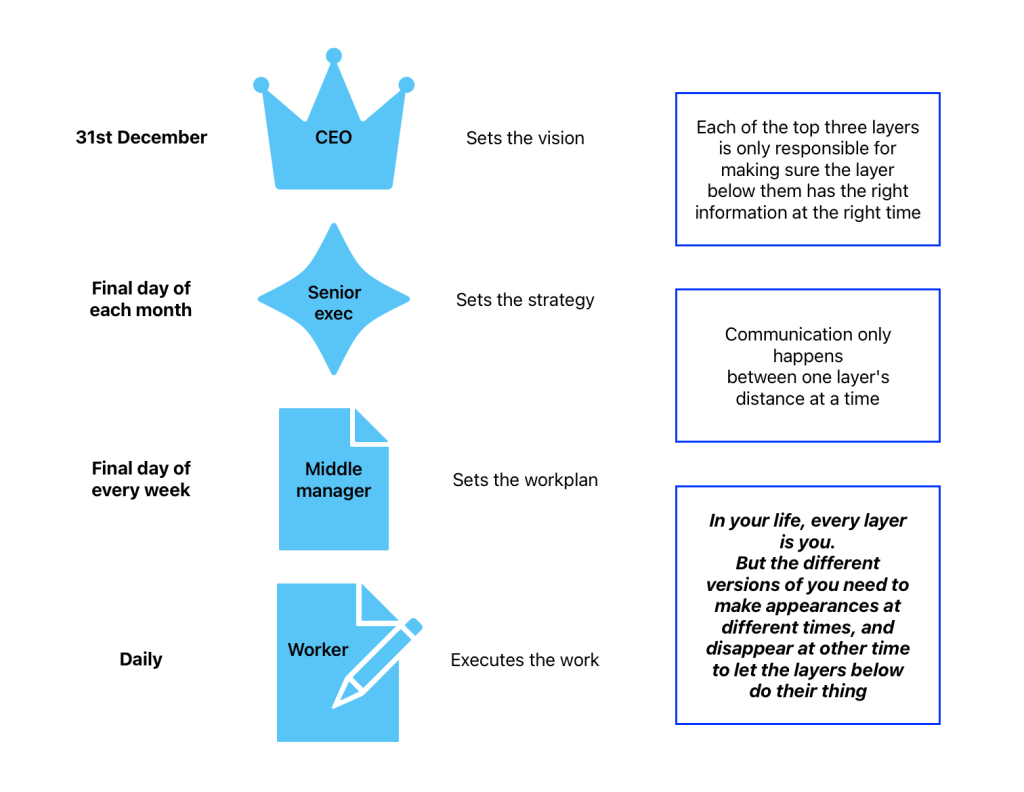
fundamentally, the skills required to set amibitious visions, and the skills required execute on work day-to-day are skills that have almost no intersection. accordingly, in companies, these roles are performed by separate people, with some manner of distance between them.
a worker needs to be focussed, have an understanding of the discrete tasks they need to complete, and be in control of their time and emotions (more on emotions later) to complete these tasks.
a ceo needs to be able to think long-term, be in touch with their real wants and needs, analyse risk and reward, and decide on and delegate reponsibility to high-level teams.
and the worker and ceo don’t really ever meet, because they don’t need to. the ceo passes the responsiblity of strategy setting to the senior exec, the senior exec helps the middle manager turn a strategy into a workplan, and the middle manager gives the workplan to the worker and the worker just executes.
how does this make any difference to my life?
i am not by nature a disciplined or motivated person, and accepting this fact this year has been freeing.
but i still want large things to happen in my life. and if i want large thing to happen, i need to start treating my life like a large thing. the tpm system gave me the clarity to treat my life like a large thing.
the trick is, you don’t actually need different people to do all these different roles in your life. you can be them all, as long as you maintain separation between each version of you.
- each year, for one day by the 31st jan, i turn on my “ceo” brain, and turn all other brains off. i think about what i really want from life, what i would do if i had no fears, and nothing to hold me back.
- at the end of each month, using the information my ceo gave me, i turn on my “senior exec” brain. i think about what each month should look like, considering i have 12 of them in total, to bring me closer to these goals.
- at the end of each week, i turn on my “middle manager” brain (yuck!) and think about what i would do each day this week to break down that monthly goal into actionable daily steps.
- and each day, i switch off all other brains, and get to work with the workplan handed down to me by my manager.
the only don’ts of the system are:
- people should rarely or never “speak” to anyone that is more than one level above or below them. confusion and issues enter the picture when you try to execute day-to-day with the biggest vision in mind, because your worker monkey brain only realistically has capacity to focus on the task at hand without combusting.
- each person can only make an appearance at their assigned times, and otherwise must (mentally) disappear. imagine trying to get on with your work and having the ceo of your company breathing down your neck. ew. in practice, this means you’re only allowed to considering changing your eg. yearly goals once a month
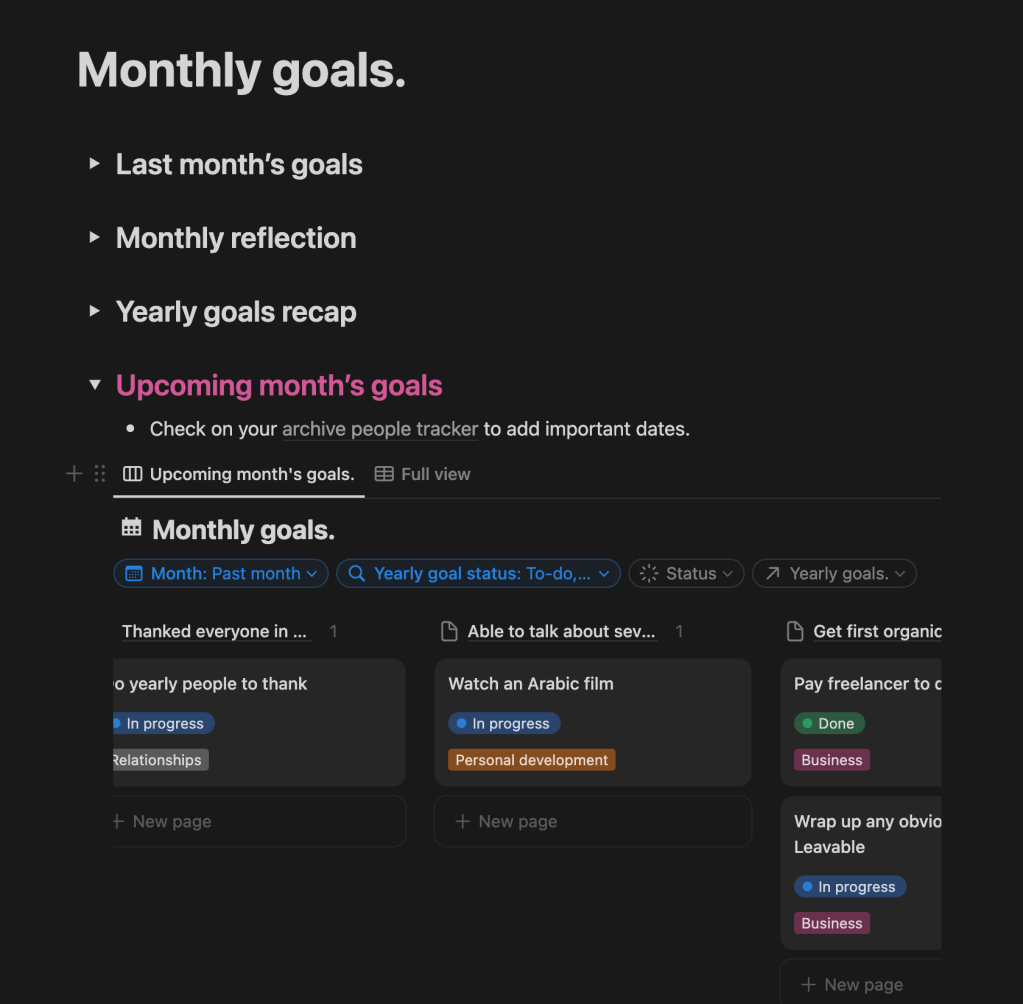
in practice, this is a bunch of relational databases in notion that feed down from a yearly database, to monthly, to weekly, to daily.
the original TPM system just uses checklists rather than databases, which makes the task management system way more manual, and way more difficult to reflect on. this year, i was able to update these all to databases.
one new feature i’ve implemented for this year in my daily planning is a ‘fear level’ check on all tasks I have to complete that day.
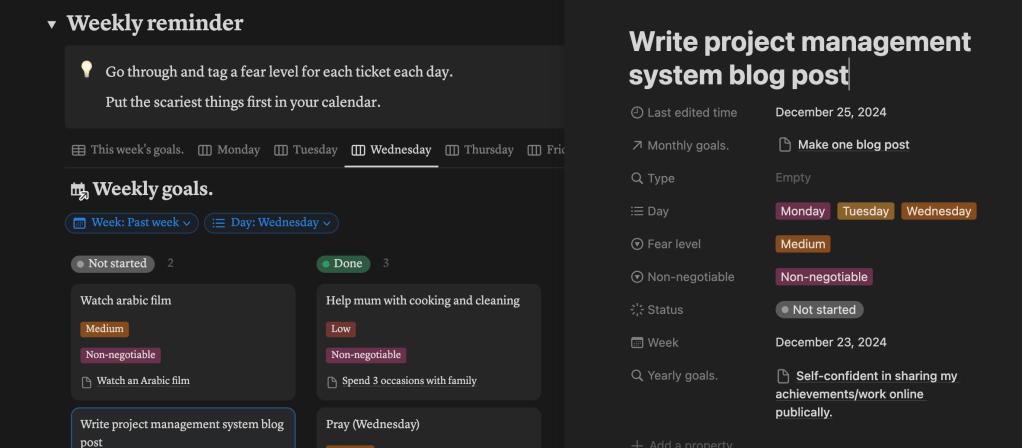
I then have to complete the tasks in order of fear level, from high to low.
emotional management has always been a huge issue for me in getting stuff done, because i find it so easy to lie to myself about why i am avoiding things. 9/10 i am avoiding out of fear, but i will tell myself i just need 10 more mins on youtube or to check one more email before i should do that thing.
have the fear label makes it less easy for me to lie to myself about my real motivations, and takes a lot of the decision fatigue away in deciding how to schedule my day.
time will only tell whether i’m still a liar or not, but i think the fact i’m writing this blog post is only thanks to the new system i put in place. you’re welcome.
 iman's trail of crumbs
Leave a comment