For the past couple of weeks, I have challenged myself to listen to songs I love and tear them apart:
I must listen and recognise for each sound, pattern, instrument, composition, and ultimately feeling, and find the words to write them all down. I immediately found I didn’t really know how to express the things I was experiencing – both technical things like key signature, song structure and effects, and feelings that I did not know how to express. Here is what I learned.
I began by asking myself – what does it mean to understand a song and drink every component in? I decided on the following questions:
# Structure
- What is the structure of the song? Where is the intro, verse, chorus, breakdowns (etc. etc.)? Are there any structures that are hard to label because they stray from any norms?
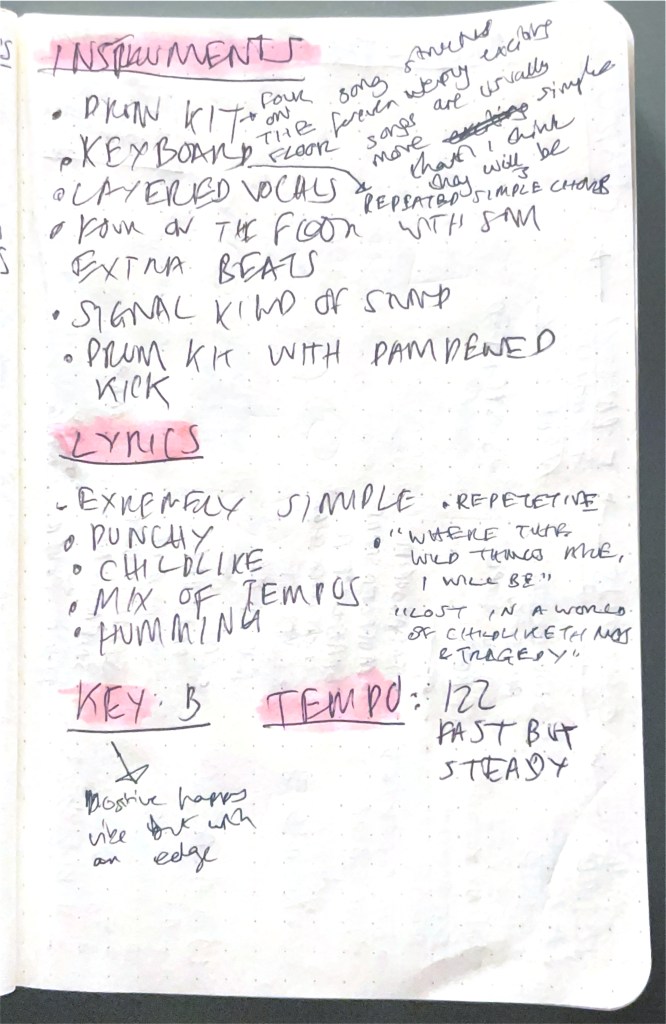
- What is the tempo/BPM and how does it affect the energy?
- What key is the song in, and does it change?
- What instruments are included? How does the presence of MIDI versus recorded instruments compare?

# Production
- What are effects are used?
- In what part of the signal flow could different effects have been applied?
- How does it fit into the album's narrative or my playlist flow?

# Feeling
- How do the different parts make me feel?
- What genre is the song? Does it mix any genres?
- What do I like about the lyrics?
- What memories or associations does this song trigger?

- What do I love about this song
- What would I change about this song, if anything?
The first song I chose was Childlike Things from FKA Twigs’ album Eusexua.
The song has an unusual ability to make me, a chronically sleepy introvert, feel so excited I want to scream every lyric into someone’s face and move my body to every beat while grinning ear to ear. North’s verse is everything. She says nothing, pure jibberish, and I feel everything – I admire this so greatly.
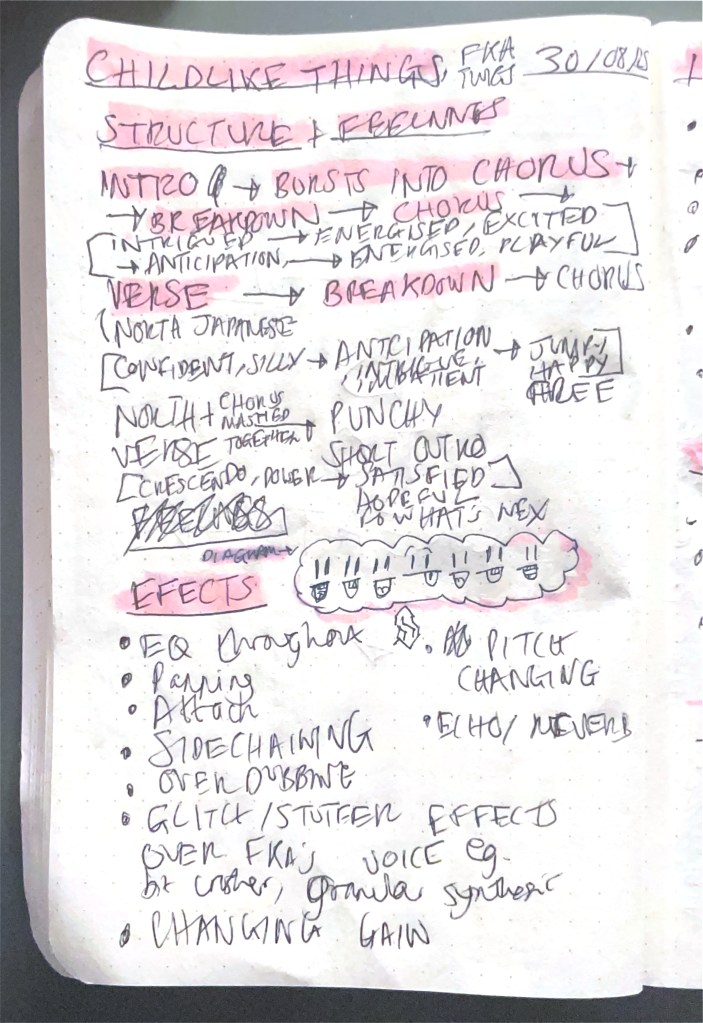
I listened to each part of the song on repeat at least 10 times each. I initially found it hard to even understand where one thing starts and another things ended, pick the basic instruments out of the track and even describe how the song basically made me feel. But I could eventually break the song down into it’s intro, chrous, breakdown, verses and outro and understand the different characters working together on the song -the four on the floor dampened drums set the steady but booming, nursery rhyme style beat, the 3 organ chord pattern that repeated and repeated with pure joy and simplicity, and the harmonies of all the little versions of twigs smiling and joking together, sing “dum dum dum, dum dum dum dum dum”. It’s truly beautiful.
I did some googling and learned the song is a reimagination of a popular 80s/90s Japanese genre called city pop. City pop is a type of upbeat funk that became popular in the 80s, and became one of the biggest influences of the vaporwave movement that swept Youtube and Soundcloud in the early 2010’s (i will always remember vaporwave as the soundtrack to my half-hearted A level revision all nighters. it’s funny how much more i remember the songs I studied to than any of the content itself.).
I learned that a breakdown is a section which appears more bare than other part of a song, but gently builds tension between one section of a song and another. Twigs’ breakdown after North’s verse is steady and builds anticipation, with the repeated sound of a sonar signal and gentle industrial thuds and slips quietly reminding us that no matter how calm the wind is we are out in the middle of a vast ocean. She whispers – “where, the wild things are, I will be. lost in a world of childlike things, and tragedy.” before bursting into the humming chorus.
I am still trying to figure out how the dragged out, grainy, irregularly glitchy effect that FKA lays over her voice the tail end of each of her verses works. this vocal effect really speaks to my soul. I’m going to try experiment with some combinations of bit crusher, granular synthesiser, sidechain compression and anything I can find through more research.
I was inspired to do these exercises because I recently complete the School of Song’s Intro to Logic course and while learning how to use the DAW itself was cool, it gave me much more of a general understanding of how producers tend to actually make music. The process of making music now feels a lot less like magic and a lot more about spending time with your tracks, being patient and listening to your intuition. And if you already have some basic concepts in your mind of what speaks to you in terms of structure, instrumentation, composition and effects, it no longer becomes magic to express yourself.
I learned that songs are generally not arranged in a particular structure from the beginning. A producer will often just make a track they like they sound of, make another track that sounds good with it, and another one, until there is a suite of sounds that the producer just likes and thinks could sound good together. They then, usually in collaboration with a songwriter or performing artist would experiment and piece together how the story of these tracks plays out.
Arranging the song then becomes like setting out the character arc of each track in the plot of a film. Tolkien would have known pretty early on that Gandalf was wise and powerful, Frodo was pure-hearted but small minded, Aragorn was a reluctant king, and Gollum was treacherous yet pathetic, and he would have known all of these things before he ever knew how Mordor would fall. But in deciding that Frodo would be gradually but inevitably corrupted by the Ring, that Aragorn would accept his destiny at the final battle, and Gollum’s obsession would ultimately destroy both himself and the Ring – he created a story that had perfect harmony with each of their intrinsic natures and the infinite threads between their stories over time. Similarly, a producer might have a haunting melody, a steady, pulsating rythmn and an unexpected vocal motif that all each feel right together sonically, but don’t really make sense either alone or all all at once. It’s only in the arrangement and interplay of the tracks that the story of the song comes alive. You want to play your characters when and where they can have the greatest impact, and allow others to have space when their time comes. As long as the story is not crowded by useless characters and the plot has an arc that speaks to you, you will have created something worth making.
i’m not used to doing things just because i like them. but art itself is just people honouring the ideas they like and feel strongly enough about to force them to exist in the world in some form. something about this always felt selfish and wrong to me, and i have always thought selfish things were bad. i have always felt out of touch with what i truly want, like, or think is magical or beautiful, even though i have always held the true artist on a pedestal. i hope that slowly starting to understand and make music will help me change this contradiction in myself. so far, living in the world of words and songs held me in each moment more than i am used to, and that can only be good.
 iman's trail of crumbs
Leave a comment