Not many memories from my teenage years feel as visceral as my hatred towards God.
To begin to unpack this, here is a little window into the stream of consciousness of my 14-year-old self:
- God hates women, and thinks they’re dumb. I hated the fact that parts of the Quran seem to refer to women as less intelligent or capable than men, to the extent that the legal testimony of two women is needed to be considered as reliable as the account of one man. I know enough male dumb fucks to know this is bullshit.
- There is so much subjectivity in religion, and simultaneously so many social norms and expectations about exactly how you should interpret things in order not to be labelled a kuffar or immoral. Not following “scholars”, not believing in hadith, believing it’s possible that the Quran could have been tampered with. All of this is considered near enough heresy in Muslim society. Nonetheless, fuck these loser dawah bros.
- Religion is full of seeming contradictions and fickle requirements. I felt disgusted that you’re not meant to adopt in Islam, when something in me has always felt a calling to adopt. The world is full of children needing love and stability. I felt disgusted that the death penalty should be an option in sharia law, when God acknowledges how fallible humans are, and acknowledges the irreversibility of death.
- Why do all non-believers have to go to hell, and why does God insist he is the one that keeps them blind? Should God really be the one going to hell, then?
- When you point out some backwards verse, like those around multiple marriages, why is the defence always that it applies to the historical context of the time when the Quran was revealed? If God is such a great, timeless writer, then why couldn’t he have written things in a way that didn’t seem so cringe and backwards centuries on?
- If God caused the big bang, then who caused God? Nothing, because God is causeless. Why are religious people such fucking cop outs?
- And when people would say “oh but it’s all open to interpretation”, that would make me feel enraged. Great, but where are the interpretations that make sense? Why does no one know where they are? And why do the people who say these things seem to say them with so much conviction, while offering so little substance?
- Self-help got me out of depression during university. Not God. Jordan Peterson told me to eat breakfast. I ate breakfast again, and slowly, I could fathom participating in life again. In hindsight, I cringe at the man that Jordan Peterson turned out to be, but at the time, that shit was hitting.
- I couldn’t fathom how some of the worst types of evil and suffering, like the abuse of children, or torture, and seemingly meaningless lives, like those who die shortly after they are born, can coexist with the idea of a meaningful God. (I still can’t)
- Religious people always use examples of religious texts seemingly making reference to scientific discoveries that were only made centuries later. I remember sitting in a Quran lesson being lectured about how marvellous it was that an ayat referred to the different densities of salt water in the Red Sea, creating lines where boats might sink or float on either side. But why can’t they have just been… good at science? Why do we need to attribute this to the divine, when people have been doing science, and maybe they were just better at it that than we thought?!
And yet, with all this rage and irritation, I open my journal and I still see calls to God written years back, from the age of 18. I remember attempts to pray even as a teenager, sometimes just in my mind, sometimes properly in salah.
On multiple occasions, I remember making mental bets with myself. “God, if you’re real, then make X happen in the next 10 seconds/10 minutes/24 hours. Then I promise I’ll believe you’re real. If it doesn’t happen, I’ll stop my back and forth about believing once and for all, because clearly then you’re not real.” Sometimes X was getting the job I’d applied for. Sometimes it was the next car that passes by being blue, or my phone buzzing in the next ten seconds. Any “miracle” would do.
X didn’t happen. But the next time, I tried with Y. Y happened! …But… what if Z doesn’t?
It basically didn’t matter what actually happened. If the thing happened, I would want to check if it was just a fluke, and would move on to the next bet. And if it didn’t happen, I didn’t hold up my end of the bargain either. If I had, I wouldn’t have kept making these bets.
What I didn’t realise at the time was that the pattern itself was more revealing than any of the outcomes. I kept talking to God, even if the subject matter didn’t make any sense.
I turned to God on the days I hated God the most.
I met my now-partner in the final year of university, around six years ago. Even though faith still lived somewhere in the back of my mind, it wasn’t something I talked about with people. Outwardly, and inwardly to a large extent, I had no faith.
I remember once striking up a conversation and talking about how irrational so much of the Quran was to me. How many contradictions there were that I couldn’t bear. How angry it made me. I expected him to agree, as in my mind, anyone born with no religion would naturally feel the same way.
To my surprise, he said he could easily see himself being part of some faith, even if it seemed imperfect to him. That he could see himself believing in things that he couldn’t see or understand. That he could just follow his heart. At some point, he also admitted that he thinks he does believe in God.
My assumptions were wrong, and I didn’t know what to do with that.
What followed was several years of going about our lives, but slowly unpeeling what faith meant to each of us. I watched how Leon respected Muslims without carrying the kind of anger I had towards the fact they were living in perceived contradictions. How he didn’t need to force rationality onto everything the way I did.
He showed genuine interest in my culture and family, more than I ever had in my twenty something years of life. He loved talking about Bollywood films. Not as a novelty or in an ironic way, but as something he actually wanted to sit down and share with me. He loves cricket and Indian food. He independently found out about Shia beliefs and traditions from my mum’s side and asked questions about them with real curiosity. He wanted to understand where I came from in a way that I had spent years distancing myself from and blocking out, and never saw the magic in.
It’s difficult to explain what happens when someone new that you love and admire embraces the parts of your identity that you’ve rejected. It’s not a conversation or an debate. It just holds up a mirror and says “look again“.
Somewhere on this road, my heart softened.
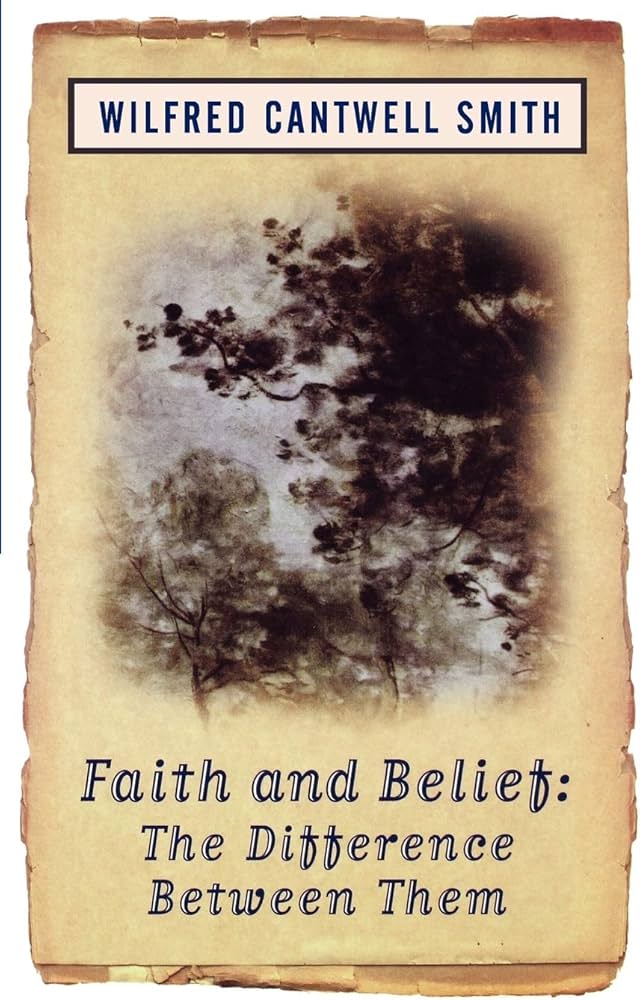
In Faith and Belief: The Difference Between Them, Wilfred Cantwell Smith traces how the word “belief” has lost its form over centuries.
The word “believe” comes from the same root as “love.” In German, belieben still means “to hold dear.” To say “I believe in God” once meant something closer to: I set my heart towards God. I pledge to live in loyalty to him. It was not an intellectual verdict. It was a decision to commit yourself to a particular way of living, continuously.
Smith compares it to a wedding. You say “I do” and commit yourself to the journey of a relationship, wherever it takes you. You don’t need to know every fact about the person first. You get involved first, and understanding follows.
Somewhere along the way, belief became about whether you think a set of propositions is factually true. Smith argues that confusing faith with belief, and then demanding belief as the entry ticket to faith, is a heresy. Faith is a stance, a willingness, a trust, a setting of your heart. It comes before belief, not after it. Belief might follow from faith, but it is not a prerequisite for it.
Smith points out the Quran doesn’t even have a word for “belief” in the modern sense. The Arabic word for faith, iman, is a verbal noun. It describes an act, something you do, not a list of facts you hold in your head.
My name is Iman. In Arabic, faith.
I have always thought this was funny, as someone chronically lacking it. But maybe I shouldn’t have been asking myself about a failure be intellectually convinced, and rather what my actions showed about my commitments. Maybe I am Faith, and Faith is not Belief.
Today, I identify as Muslim, but I now believe that Islamic practice today is probably wrong in almost every facet and popular interpretation. I believe that many of the beliefs that 14-year-old me had at the start are just a result of only having ever seen the most popular, 21st-century-sharia-style interpretations of the issues. This viewpoint, that almost all respected Islamic scholarly interpretations are wrong on most issues, might never be considered an acceptable viewpoint, but that’s where I am.
I also believe that this isn’t a good enough excuse to abandon God. The two things can be separated, and separating them is the only choice I have to be at peace.
I still ask myself whether my “soft heart” is really an excuse for losing the courage to question contradiction.
I don’t have an answer. But in the absence of one, I will continue to fast, to give to charity, to be kind to others, to talk to God and to pray and to seek pilgrimage when I can. I choose the faith, even when I can’t choose the belief. And for now, that commitment is enough.
 iman's trail of crumbs
Leave a comment